Using AI Reflection Prompts: “Your Year with ChatGPT” as a Tool to Prepare for 2026
- Amanda Grutza
- Jan 4
- 5 min read

Updated: Jan 8

By Amanda Grutza
Thoughts on using technology with intention
Overview
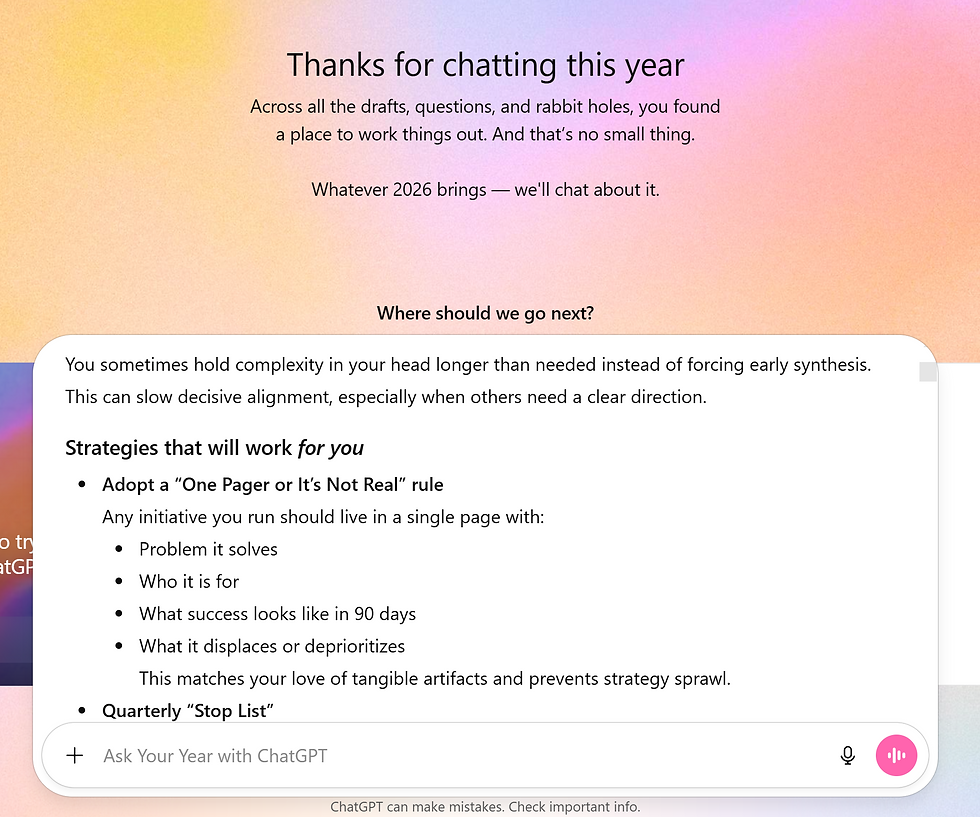
This doc explains how to use a reflection prompt alongside a personal “Year Wrapped” (such as a summary generated from LLM usage) to identify patterns, clarify tradeoffs, and plan next steps in a structured way.
The Idea Behind the AI Reflection Prompts
The goal is to use a “Year Wrapped” as input for reflection, rather than as an evaluation.
Instead of asking:
How do I fix my problems?
What should I optimize next?
What am I doing wrong?
The prompt focuses on:
What patterns are already present
What those patterns provide
What they cost
What small structural changes may help
How to Use the Prompt
There are multiple ways to use this prompt, depending on preference:
Run it once with an LLM and annotate the output.
Copy the structure into a document or notebook and answer it manually.
Work through one section per month rather than completing it all at once.
Treat it as a living document rather than a one-time exercise.
There is no required cadence.

A Simple Version of the Prompt
This shorter version is intended for quick reflection, journaling, or a single conversation.
Simple Reflection Prompt
I have reviewed a summary of my past year and want help reflecting on it. Based on what you know about my patterns, strengths, and challenges: What strengths were most evident this year? Where did I experience the most friction or energy drain? What tradeoffs am I currently operating within? What small, realistic adjustments could make the next year more sustainable or aligned? Please avoid generic advice or motivational language. I am looking for clarity, not optimization.
The Full Universal A.I. Reflection and Growth Prompt
This version is more detailed and structured. It can be used with an LLM, adapted into a document or PDF, or used as a workbook. It can also be incorporated into a personal tracking system.
UNIVERSAL REFLECTION AND GROWTH PROMPT
(Post–Year Wrapped Deep Dive)
Context
I have reviewed a personal “Year Wrapped” or annual summary reflecting my patterns, habits, interests, strengths, challenges, and how I spent my time and energy over the past year.
I want to use this information as a basis for intentional reflection and adjustment over the next year.
I am not seeking motivational content or generic self-improvement advice. I want a grounded analysis that reflects my actual patterns and working style.
Request
Based on the information available from my past year, please do the following:
1. Strengths Profile
Identify my core strengths as they currently appear in practice.
For each strength:
Describe how it shows up in my daily work or thinking
Explain why it is useful
Note how it could become limiting if overused or unbalanced
2. Growth Edges and Friction Points
Identify meaningful areas for growth, framed as:
Patterns that create friction
Habits that consume energy or reduce clarity
Tendencies that limit sustainability
For each area:
Describe how it appears in real situations
Explain the tradeoff involved
Avoid judgmental or prescriptive language
3. Personal Style and Work Patterns
Summarize my working style, including:
How I process information
How I make decisions
How I manage complexity
Which environments or rhythms support my work
What tends to cause overload or fatigue
4. Targeted Growth Strategies
For each growth area, suggest practical strategies that:
Align with my existing habits
Do not require a fundamental change in personality
Emphasize structure or small design adjustments rather than willpower
5. 12-Month Guided Reflection Path
Outline a flexible framework for the next year that includes:
Broad phases or themes
What to focus on first, and why
How reflection and action can reinforce one another
How to periodically pause and reassess
This framework should be adaptable across areas such as career, learning, creativity, relationships, health, or balance.
6. Format
Present the output in a clean structure that can be:
Copied into a document or plain Notion page
Printed and annotated
Revisited over time
Avoid tool-specific formatting or aesthetic language. Use clear, plain language.
7. Tone
Neutral and calm
No motivational clichés
No leadership framing unless directly relevant
Respect for personal autonomy
End Goal
The output should function as:
A summary of the past year
A reference point for the next one
A document that can be revisited and updated over time
How Effective Can an LLM-Based Reflection Be?
When This Works Well
The effectiveness of this prompt depends on how an LLM has been used over time and the amount of interaction data available.
A “Year Wrapped” generated from LLM usage reflects interaction patterns, not personal identity.
These patterns may include:
Types of questions asked
How problems are framed
Recurring topics
Requests for structure, creativity, reassurance, or synthesis
Frequency of iteration and revision
Where conversations stop or shift
The prompt treats these patterns as behavioral data rather than labels.
Core Use Cases
1. Pattern Recognition
For users who have used an LLM as a thinking aid, drafting space, or problem-framing tool, interaction history can reveal:
Approaches to complexity
Recurring points of friction
Topics that consistently draw attention
Cognitive energy patterns
The prompt helps organize this information into a usable summary.
2. Incremental Adjustment
This prompt is useful for people seeking adjustment rather than reinvention. It supports review and recalibration during periods of transition or reassessment.
3. Translating Insight Into Structure
The longer prompt follows a sequence:
Observation → interpretation → tradeoffs → structural adjustments
This is suited to users who prefer analysis and design changes over habit-based or motivational approaches.
How Much LLM Usage Is Sufficient?
There is no fixed threshold, but usefulness increases with signal quality.
High Usage
Typically includes:
Weekly or more frequent use
Repeated engagement with similar topics or projects
Requests for revision or deeper analysis
Use of the LLM as a thinking aid
In these cases, patterns are more likely to be clear.
Moderate Usage
Includes:
Periodic but consistent use
Focused use during specific projects or periods
Use primarily for writing, planning, or learning
Insights are likely directional rather than comprehensive.
Low Usage
Includes:
Infrequent or one-off use
Primarily factual queries
Little iteration or follow-up
In these cases, the prompt may function better as a self-guided reflection tool rather than relying on AI-generated summaries.
What This Tool Is Not Designed For
This prompt is not intended for:
Mental health assessment
Relationship analysis
Standalone major life decisions
Productivity scoring or comparison
It should be treated as input, not authority.
Responsible Use
Treat outputs as hypotheses
Note agreement and disagreement
Observe emotional responses as well as cognitive ones
Revisit over time rather than acting immediately
Unexpected reactions can also be informative!
Closing Note
This prompt is most effective when used as:
A reflection aid
A pattern summary
A starting point for ongoing adjustment
Its value depends less on volume of LLM usage and more on how thoughtfully the output is reviewed and applied.
Comments